List of contents
Introduction: The Myth of “Waiting for the Mood”
In the professional world, we often fall into one fatal illusion: the belief that we have to “feel motivated” before we can start working. We wait for the mood to come like waiting for lightning to strike. The problem is, in the long term, this strategy is not sustainable.
Modern science proves that the order is actually reversed. Motivation is not a trigger for action, but rather the result of action. There is a specific biological mechanism in the brain that regulates this drive, and its control center is called Dopamine.
In our modern brain, there is a prefrontal cortex circuit that acts as the "CEO". This section sets goals, monitors progress, and resists the urge to give up.
This circuit relies heavily on feedback. Without clear indicators of progress, the prefrontal cortex doesn't get enough feedback signals to sustain effort.
Edwin A. Locke and Gary P. Latham in Goal Setting Theory (2002) found that clear goals significantly increase cognitive focus. Their research proves that the human brain is biologically more motivated when it has measurable success parameters.
If you feel tired of studying without results, it's because the CEO in your brain (prefrontal cortex) is blind. He ran out of fuel because he didn't see the finish line.
This is the heart of our motivation engine: Dopamine. However, the common understanding of dopamine is often misguided. Dopamine is not just a “happy molecule.”
Wolfram Schultz in the journal Science (1997) dissected this mechanism with precision. Dopamine cells in an area of the brain called the Ventral Tegmental Area (VTA) are active based on a principle called Reward Prediction Error.
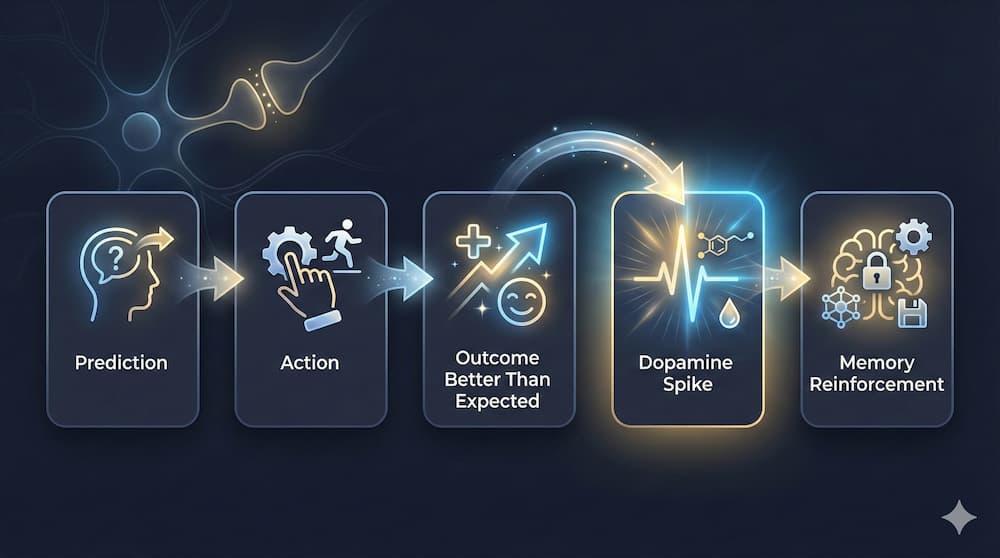
What is Reward Prediction Error? This mechanism works by comparing Expectations vs Reality.
- Prediction: The brain predicts the outcome of an action.
- Action: We perform the action.
- Evaluation:
- If the results match predictions = Dopamine is stable.
- If results exceed predictions (better/faster) = Dopamine Surge.
- If the results are disappointing = Dopamine drops (frustration).
This dopamine surge doesn't just make us feel satisfied. More importantly, it serves as a learning signal. Dopamine strengthens the neural pathways (synapses) associated with the behavior.
Here's the biological application of Hebb's rule ( Neurons that fire together, wire together): Behaviors that produce dopamine will have stronger neuron connections, making us more likely to repeat the behavior automatically in the future.
Neuroscience Insight: Why Do We Love “Winning”?
Many people mistakenly think of dopamine as just a “pleasure substance”. In fact, its evolutionary function is much more strategic.
According to research by Wolfram Schultz (1997), dopamine cells are active when what is called a Reward Prediction Error occurs. Simply put, dopamine is released when the brain predicts an outcome (reward), and the reality that occurs meets or exceeds these expectations.
Analogy: Slot Machines vs. Monthly Paycheck Imagine the difference in feeling when you receive your monthly paycheck (routine, predictable) versus when you win a small lottery or successfully solve a difficult coding problem after hours (surprise, accomplishment).
- In the second case, the brain shouts: "My guess was right! My attempt was successful!"
- It is this surge of dopamine that strengthens the neural pathways (synapses), making the brain record the activity as something “worth repeating”.
This is why we can enjoy playing games for hours, but find it difficult to last 30 minutes reading a textbook. Games provide instant dopamine feedback every time we level up, whereas big tasks are often devoid of short-term “rewards.”
Applicable Steps: 3 Ways to Design Your Own Dopamine System
How do you bring this “addiction” mechanism into your work or learning process? Here is an applicable framework based on neuroscientific principles:
1. Convert Big Visions Into “Micro-Goals” (Law of Chunking)
The human brain has limited short-term memory and tends to be anxious when facing large abstract tasks. Goals like “Become a Data Science expert” or “Build a Startup Business” are too far away for the daily dopamine system to process. There is no instant reward there.
Applicative Strategy: Use the principle of Chunking to break down the big vision into Micro-Goals that can be completed in one sitting.
- Incorrect: “Working on the annual report today.” (Too abstract, confused brain to start with).
- Correct: “Write 3 introductory paragraphs in the next 20 minutes.” (Specific, measurable).
Every time you complete a micro-goal, the brain gets a small success signal. Dopamine is released, providing fuel to move on to the next task.
2. Create Instant Visual Feedback (The Feedback Loop)
Dopamine is very time sensitive. The sooner you realize that you are successful, the stronger the effect will be. If you wait for your boss's assessment at the end of the month, your daily momentum will die.
Applicable Strategy:
- Physical Checklist: Make a list of micro-goals on paper. When the task is completed, physically cross it out in thick ink. This visual act of crossing out signals satisfying closure to the brain.
- Quick Self-Testing: If you're studying, do a self-test as soon as a chapter is finished. Successfully answering questions triggers a feeling of satisfaction ( reward) which strengthens memory.
Remember Hebb's principle: “Neurons that fire together, wire together”. The more often you experience “done” moments (even small ones), the stronger the motivational wires in your brain are connected.

3. Manage the Difficulty Level in the “Golden Zone”
Dopamine is tricky. If the challenge is too easy, the brain gets bored (no reward spike). If it's too difficult, the brain is stressed (cortisol rises, motivation falls).
Locke & Latham research shows that the highest motivation occurs when challenge is balanced with skill .
Applicable Strategy:
- If you keep putting off work, ask: “Is this too hard or too boring?”
- If it's too difficult: Break the task into smaller pieces ( micro-chunking).
- If it's too easy: Challenge yourself with a time limit (e.g. “Can I finish this in 15 minutes instead of 30 minutes?”).
The flexibility to adjust targets midway ensures your brain keeps getting reward signals without getting stuck in frustration.
Conclusion: You Are the Architect of Your Own Motivation
Waiting for inspiration is an amateur strategy. Professionals create their own momentum.
By breaking down goals into concrete steps ( micro-goals), providing instant visual validation ( checklists), and maintaining a balance of challenges, you are actually “hacking” your brain's own biological systems.
You are no longer working hard against your brain; You work with him. Start today with one simple question: “What is one small thing I can get done and cross off my list in the next 15 minutes?”
Key References:
- Schultz, W. (1997). Dopamine neurons and their role in reward prediction.
- Locke, E. A., & Latham, G. P. (2002). Building a practically useful theory of goal setting and task motivation.
- Miller, G. A. (1956). The magical number seven, plus or minus two.
- Mithen, S. (1996). The Prehistory of the Mind.

Written by
Former professor and activist of literature, culture, and science and technology. Share thoughts, care for cultural heritage, and build learning spaces together.
View 302 posts
No Comments
Leave a comment Cancel